From King William III to Queen Wilhelmina: the tragic road to the throne
Three sons, one daughter, enough potential heirs to the throne, you would think, but nothing could be further from the truth. The eventual path of succession to the throne of King William III was marked by considerable misfortune, with three heirs dying before they could ever ascend the throne. What exactly happened?
William III was the third King of the Netherlands after his father King William II and the well-known King William I, the founder of the Kingdom of the Netherlands as we know it today. Ascending the throne in 1849, he was a controversial monarch who, alongside a turbulent reign, also had an equally turbulent path to succession. And that began with his first (unhappy) marriage, namely to Princess Sophie of Württemberg.
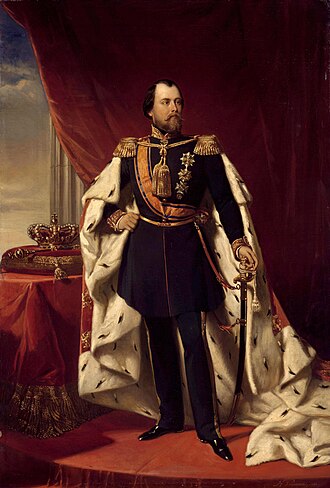
Despite it being an unhappy marriage, their first son, and thus the first in line to the throne, William Nicolaas Alexander Frederik Karel Hendrik was born in 1840, with the nickname WiWill. Three years later, in 1843, his younger brother William Frederik Maurits Alexander Hendrik Karel, nickname Maurits, was born, followed in 1851 by William Alexander Carel Hendrik Frederik, nickname Alexander. The succession seemed secure, or so it was thought. But things turned out differently.
The second son, Prince Maurits, died as early as 1850 at the age of 6 from meningitis. Maurits had been in poor health from the very beginning, and due to most likely incorrect earlier diagnoses, his condition eventually became so critical that treatment was no longer effective. This left two direct heirs still alive.
The Crown Prince did reach adulthood, but nevertheless did not live long. WiWill died in 1879 at the age of 38 from "combined ailments", which are generally believed to have been primarily pneumonia. WiWill was known for leading a rather dissolute life, which earned him a poor reputation. His relationship with his father was also far from good. Rejected marriages, exclusion from important decisions, and his departure to Paris did not help matters. At the time of his death, the king showed little concern for the legacy of the deceased heir and rejected it. The Palace on the Kneuterdijk, where WiWill had lived in his adult years, was sold to the municipality of The Hague. WiWill’s younger brother Alexander found this dreadful and therefore repurchased the palace with his own funds, although he never lived there.
This meant that Alexander now became Crown Prince and thus the heir to the throne. Unfortunately, Alexander also did not live much longer and died five years later in 1884 at the age of 32, most likely from typhus. Alexander too had been in relatively poor health since birth. His relationship with William III was also not particularly strong, where William III had been closely involved in the upbringing of his eldest son, he was hardly involved in that of his youngest. After the death of his beloved mother, he could, by modern standards, be described as depressed, although this is a modern interpretation and not a diagnosis from his own time. He withdrew from public life and fulfilled few, if any, official duties as Crown Prince. All of this did nothing to improve his health.
And so, all possible male heirs had died before William III had passed on the throne. None of the princes had married or produced children. A tragic chain of events, but after the death of Princess Sophie, the king remarried, this time to Princess Emma. From this marriage, four years before Alexander’s death, one daughter was born, the future Queen Wilhelmina. Wilhelmina’s position was only secure when King William III died in 1890 without leaving a male heir. Constitutionally, male heirs had priority over female heirs at the time. When the king died, Wilhelmina was only 10 years old, and therefore Princess Emma acted as regent until her 18th birthday. Wilhelmina, unlike her half brothers, was not eligible to succeed to the Grand Duchy of Luxembourg, as its constitution allowed only male heirs. As a result, it passed to a distant relative from the House of Nassau.
This marked the first time a queen came to power in the Kingdom of the Netherlands, after three kings had ruled. It would take until the current king, at the time of writing, for the Netherlands to have a male monarch again, after a succession of queens, Wilhelmina, Juliana, Beatrix. Why was King William Alexander not named William IV? He had the following to say about it: "William IV stands next to cow number 38 in the meadow," referring to the fact that he found it too impersonal. After all, he had been known his entire life as William Alexander.
And with that, we have reached the end of the story of a remarkable timeline of succession. There is, of course, much more to tell about the princes and princesses mentioned, but that will be saved for a new series of articles.