De van der Schueren, knight in a modern era: a brief interview
Castles, horses and armour are typical stereotypes many people associate with the word knight. Yet knights still exist today, albeit without these attributes, but no less interesting because of it. In this interview, Maurice ridder de van der Schueren shares his views and insights on this title.
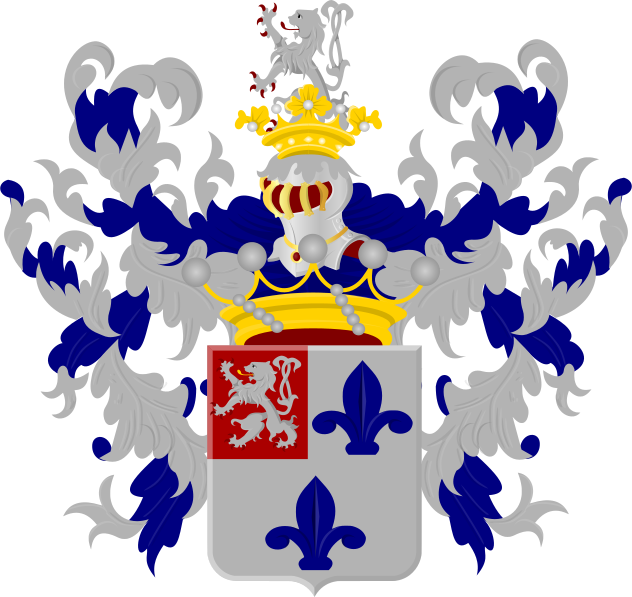
The noble title of knight stands above the untitled nobility and just below that of baron. At present, there are only seven noble families in the Netherlands that still hold this title, considerably fewer than titles such as baron and count. This has a historical cause, as the title of knight has always been granted very sparingly. It is also noteworthy that knight is the only title within the Dutch nobility without a female counterpart. In such cases, the predicate jonkvrouw is used. The de van der Schueren family was incorporated into the Dutch nobility in 1821 with the title of knight. Maurice, knight de van der Schueren, is a member of this distinctive family and was willing to answer a number of questions.
Dr. Maurice H.F. knight de van der Schueren works as a university lecturer and researcher at the University of Groningen, where he is engaged in research on social inequality, elites, and family and network analysis. In addition to his academic work, he is active in cultural and historical organisations, including those concerned with heritage, genealogy, and traditions, which naturally aligns well with his family history. It is precisely this combination of science, history, and social engagement that characterises him most.
He experiences his noble title more as a historical particularity and a formal designation in certain contexts (historical or ceremonial) rather than as something elevated. The awareness that it concerns an almost closed chapter in Dutch history makes it interesting, according to Maurice. “It mainly says something about the past of my family, not about who I am today or what I do.”
There are hardly any advantages to the title. Apart from the fact that it sometimes arouses curiosity, people also sometimes hold prejudices. This can at times be a disadvantage, as people quickly make assumptions that are not always correct. Typical prejudices such as country estates, horse riding, and wearing a suit of armour are in Maurice’s case absolutely not true.
Maurice grew up with an awareness of his noble background, although it did not play an overriding role in his upbringing. The focus lay more on responsibility, education, and social engagement. The interest was present, however, and manifested itself in intensive genealogical and historical research into his family and into the Dutch nobility in general. His fascination made him particularly aware of how strongly family history is intertwined with broader social structures. “What often remains underexposed is how diverse the life courses within a single noble family can be,” according to Maurice. Furthermore, the noble background plays a modest role within the family. Traditions consist mainly of stories, documents, and certain practices, not of specific formal rituals. There is sometimes contact with other noble families as well, but this is purely in the context of research, culture, events, or associations.
Regarding the role of nobility in modern times, he mainly sees the nobility as a bearer of heritage, history, and sometimes networks, thus not as a privileged social, legal, or political position. Culturally and symbolically it is important, but as Maurice himself puts it: “Nobility today is mainly a historical phenomenon with a contemporary shadow.” Although he considers symbolic appreciation for long-term commitment to be a good thing, he does not believe that its hereditary nature still fits the present time. For that reason, he prefers distinctions and orders such as the Order of the Netherlands Lion, the Order of Orange-Nassau, and the Military William Order as a form of distinction. Maurice sees the monarchy itself, including the nobility, as historical institutions that must continually justify themselves in a modern society. “Their value, in my view, does not lie in power or status, but in continuity, symbolism, and social service,” according to Maurice.
It is always special to hear the views, history, and standpoints of someone who is genuinely part of the Dutch nobility, especially when that person, like Maurice, has conducted so much research into the subject. This results in a nuanced and clear picture and forms a valuable contribution to the various opinions and perspectives on the concept of nobility, both in a historical and contemporary sense.
With thanks to Dr. Maurice H.F. knight de van der Schueren for the time he made available and for sharing his story and his perspective on nobility in modern times.