The (Lost) Dukes of the Netherlands
The Netherlands knows dukes, and yet it does not. How does that work? Behind this apparent contradiction lies a long and fascinating history, beginning in the early Middle Ages and continuing up to Belgian independence. We make several jumps through history and into the present to show how the current situation came to be.
The history of dukes begins quite early in the Middle Ages, long before there was any notion of a Dutch state. One of the earliest duchies partly located in what is now the Netherlands was Lower Lotharingia. In the 11th and 12th centuries, several duchies developed, such as the Duchy of Brabant, Guelders, and Limburg. The title of duke was originally not a hereditary noble rank, but rather a military and administrative function. Dukes were landsmen in this period and, in some cases, comparable in power to kings. A duke was therefore an important figure in the early history of the Netherlands, even though the Netherlands as a state did not yet exist.
In the 14th and 15th centuries, the role of the duke changed significantly. Whereas dukes were initially regional rulers, the title increasingly became part of a broader collection of titles held by rulers over a wider territory. At the same time, through the unification of multiple territories, the title of duke was increasingly passed on hereditarily. After the Burgundian period, under the Habsburg Netherlands, the duke became increasingly absent. Governance came into the hands of stadtholders and councils. While the title continued to exist, it lost its direct connection to local administration.
The Dutch Revolt marked a turning point in the history of Dutch dukes. In the northern Netherlands (roughly corresponding to the present-day Dutch territory), ducal titles became associated with the Spanish rulers, which was, understandably, politically unacceptable. In the north, the ducal title was pushed out of politics, while it continued to exist in the Southern Netherlands, which remained under the Spanish monarchy in contrast to the new Republic. Here, for the first time, a major divide emerged between North and South that would later prove decisive.
We then make a leap to 1815, when the north and south were united in the United Kingdom of the Netherlands under King William I. As a result, dukes once again fell within the newly established Dutch nobility, though still exclusively in the southern part of the kingdom. However, the United Kingdom was short-lived, and in 1830 the south became independent as the Kingdom of Belgium. Since the dukes resided within the territory of the new Belgium, they transitioned into the Belgian nobility. As a result, the (northern) Dutch nobility once again found itself without dukes.
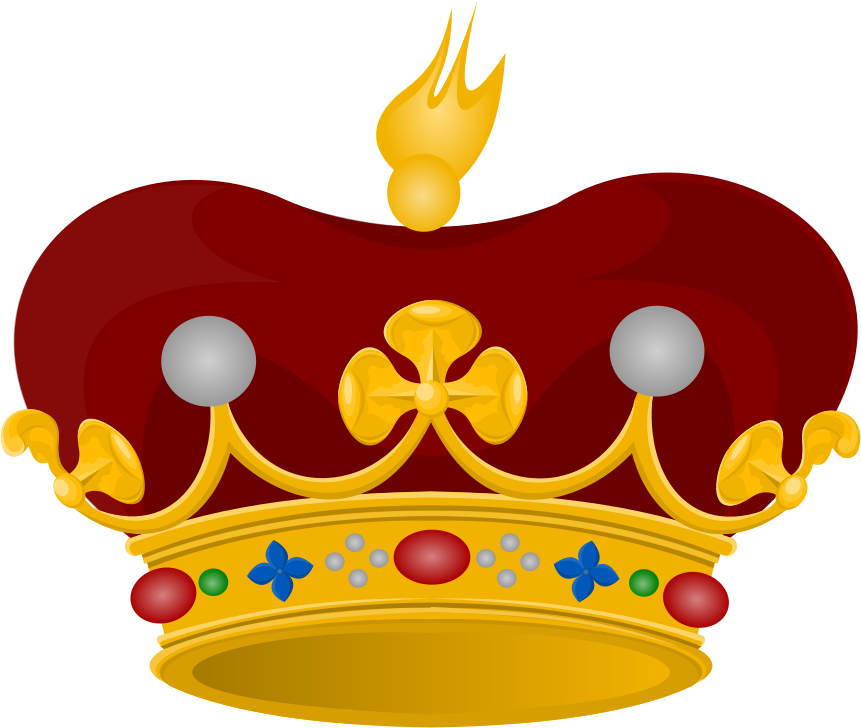
Although the title officially still exists within the noble statutes, including descriptions of the ducal coronet, the Netherlands has not known any dukes since 1830. While several noble grants were still conferred, these were largely limited to comital titles and below. Only in rare cases was the title of marquis granted, but never that of duke. This was not the result of an official legal decision, but rather of practice. There is no explicit evidence, but it is generally assumed that the title of duke was no longer granted due to its association with old territorial power structures, combined with the fact that the title was considered too “heavy” in relation to the king. The Netherlands sought nobility as a form of social recognition, not as a power structure.
It is not known whether any applications were made after 1830 for the incorporation of dukes into the Dutch nobility, but the fact remains that there have been no dukes since Belgian independence in 1830. Personally, I regret that in this way more and more noble titles have been lost. For exceptional personal merit, it would be wonderful to see a ducal title granted again, purely as a symbolic honor, devoid of any political or legal significance.