The last marquess of the Netherlands: the Marquess of Heusden
Historically, the Dutch nobility has known very few marquesses, partly because the Netherlands never truly had border marches. Compared to other titles, such as baron and count, the title of marquess was rarely granted. As a result, there is today only one marquess within the Dutch nobility, namely the Marquess of Heusden.
Before continuing, it should be noted that the Dutch king traditionally also holds the title Marquess of Veere and Vlissingen. The king, however, stands above the Dutch nobility and does not form part of the noble estate, which means that this title is of a different nature.
The Marquess of Heusden, then: a high noble title connected to a relatively small (restored) fortified town. Present-day Heusden has approximately 1,315 inhabitants. Despite its modest size, the town has a rich and significant history, which falls outside the scope of this article. Fortunately, the title and its origin are at least as interesting.
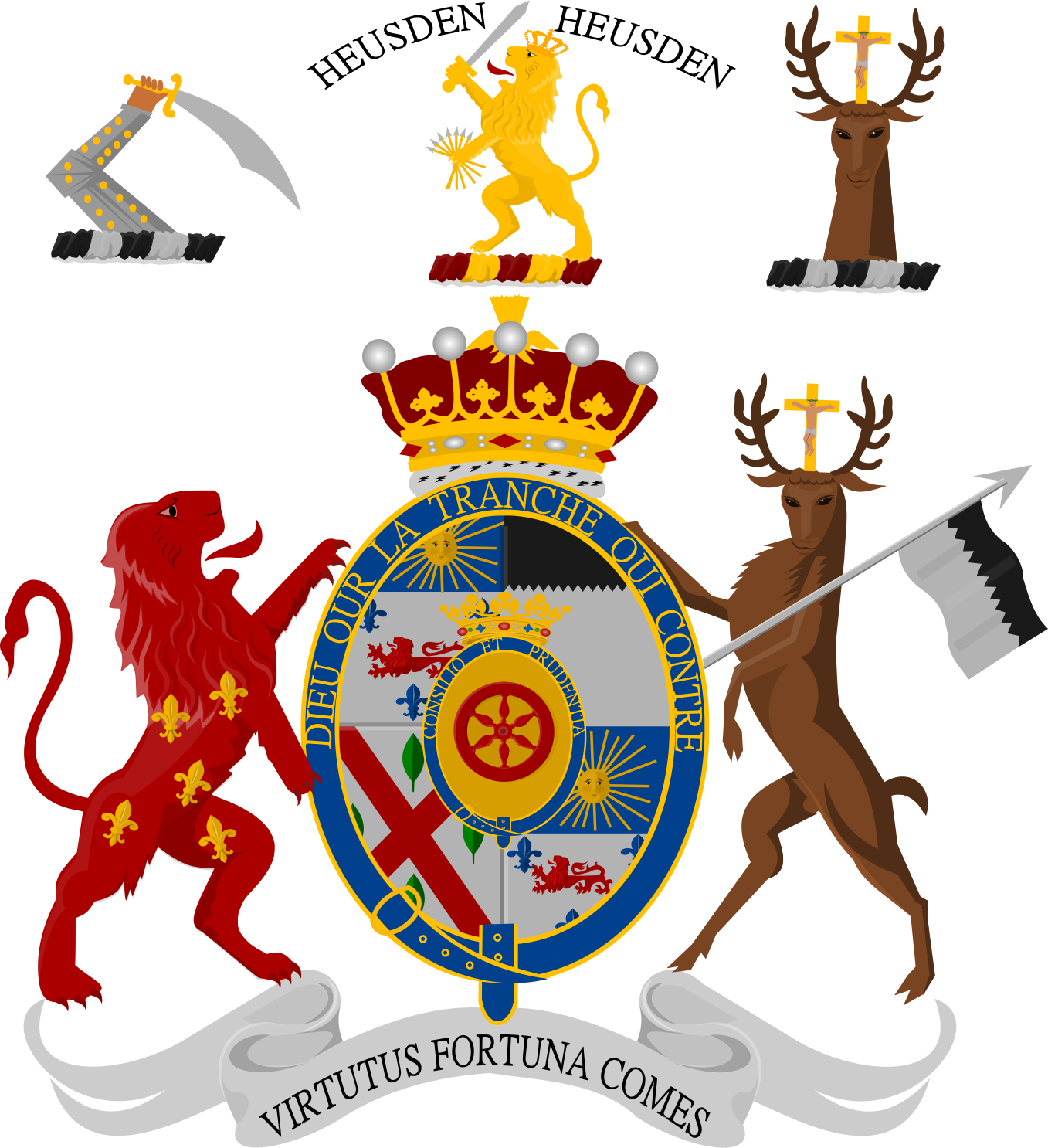
The title Marquess of Heusden was specially created by William I for Richard Le Poer Trench, in recognition of his services as British ambassador in The Hague during the period 1813–1815. Le Poer Trench played an important role in resolving territorial and administrative boundary disputes in Holland, various German states, and parts of Italy at the Congress of Vienna. In addition, he was a crucial ally of the young Kingdom of the Netherlands under King William I. Owing to these merits and his contribution to the stabilization of the new kingdom, he was elevated to the Dutch nobility in 1815.
The creation of the title did not mean that Heusden became a marquisate. Alongside this unique title, several other privileges were associated with his elevation. He was promised an annual endowment of 10,000 guilders and was granted permission to augment his family coat of arms, including the wheel from the arms of Heusden.
It is generally assumed that this annual endowment was never implemented, as the States General did not agree to it. Moreover, no archival evidence has been found that the payment was ever actually made.
As mentioned earlier, the Marquess of Heusden was an Englishman. A remarkable historical fact is that he was one of only two non-Dutch individuals ever elevated to the Dutch nobility, the other being the Prince of Waterloo. Such a foreign elevation is, from a legal perspective, no longer possible since the introduction of the modern law on nobility.
In addition to his Dutch title, Le Poer Trench also held the British title Earl of Clancarty and had a seat in the House of Lords. The title Marquess of Heusden is inheritable by primogeniture in the male line and has now been passed on eight times.
The current and most likely last holder of the title is Le Poer Trench, the 9th Marquess of Heusden. There is a strong likelihood that the title will become extinct with him, as he has only one daughter and the title can be transmitted solely through the male line. The present Marquess is also a member of the House of Lords and is additionally active as an independent visual artist.
Although there is no evidence that any holder of the title Marquess of Heusden ever actually visited the town of Heusden, it nevertheless represents a remarkable chapter of Dutch history. It is a unique noble title, created in recognition of exceptional services to the Netherlands, an honour and distinction that continues to endure to this day.
While decorations are fleeting, noble titles constitute a lasting honour: visible and meaningful, even generations later. The Marquess of Heusden is a striking example of this.
This article has been written independently and for informational purposes only. The current Marquess of Heusden, Nicholas Le Poer Trench, was not involved in any way in the writing or compilation of this content.